Borrowed Taste
Expecting outputs from a culture you haven't built yet.

Something jumped out at me that I’d never seen so explicitly communicated in a job description before.
Typically you see general references to brands or companies, or contexts that they would like candidates to have experience from.
But this Head of Brand Marketing role was very direct.
Even though it finishes with a “If some of the above doesn’t line up perfectly with your experience, we still encourage you to apply…”.
“We’re deliberately broad here.
Strong candidates might come from:In-house brand or creative leadership at culture-forward consumer or tech brands (think Apple, Nike, Aesop, Glossier, On, Stripe, Figma, Linear, Arc, A24, Mejuri, Aimé Leon Dore, MSCHF, Liquid Death)
Creative direction at top-tier agencies (Mother, Wieden+Kennedy, Gretel, Pentagram, Collins, Instrument)
Editorial leadership at publications or media brands with strong cultural authority
Brand or creative roles at fashion houses, record labels, design studios, or cultural institutions
Nice to have
Direct experience marketing technical products to technical buyers.
A network in the design, fashion, music, or publishing worlds we’d be lucky to inherit.
A point of view on how AI is changing creative work, and how brands should respond.”
Let me tell a story...
I once worked with a leader in a new role who, when starting their new role identified a real moment of leverage to put their brand’s positioning in the media discourse with a bold and opinionated advertising play at an important moment for the business.
Even though the idea was for the most part the “right” thing to do, it made a lot of people uncomfortable. What should have been a yes/no decision in a 30-minute meeting and completed within the day, turned into weeks-long discussions on everything from company values to whether there was budget for such an activity. Long story short, the final recommendation was instead to just make a Linkedin post about the topic instead.
The moment was gone.
You can argue about whether the messaging or place to play was right or not.
But more than any workshop could show, the attempt revealed the organization's true values and ways of working. Not their aspirational equivalents. what the attempt revealed was the organisation's true ways of working and conviction — more than any workshop could"
It showed that the brand was perhaps a bit more introverted in personality than what people believed. It showed that consensus and process were valued more highly than just “getting things done.” It showed that in some instances speed to decision making wasn’t truly a priority. And it showed that truly distributing authority and responsibility to action was a lot more complicated than it sounds.
Like the job example above, this person I reference in the anecdote came from a similar set-up, somewhere known and admired for its products and how it shows up in the world.
The brands mentioned above share some similar traits. Not exclusive to all but for example when I see that list I think of: aesthetic consistency; narrative coherence; a challenger ethos; points of view; and participating in and sometimes shaping culture.
For the leader with the new initiative who was brought in to “mix things up” and sharpen their position, it didn’t work. The belief, conviction, shared language and the culture were not there. The new host organization didn’t accept it and rejected the sensibility, taste, judgement and creativity of the person they hired and contradicted what they said they aspired to be. And not because of some grand evil plan, just the nature of when a new idea meets organizational resistance.
They didn’t want to do the work; make the change; or just thought they could buy the vibe.
And I see a this show up time and again, especially with new hires that are tasked with doing something new - growth, innovation, culture change etc. versus hires to maintain systems and status quo.
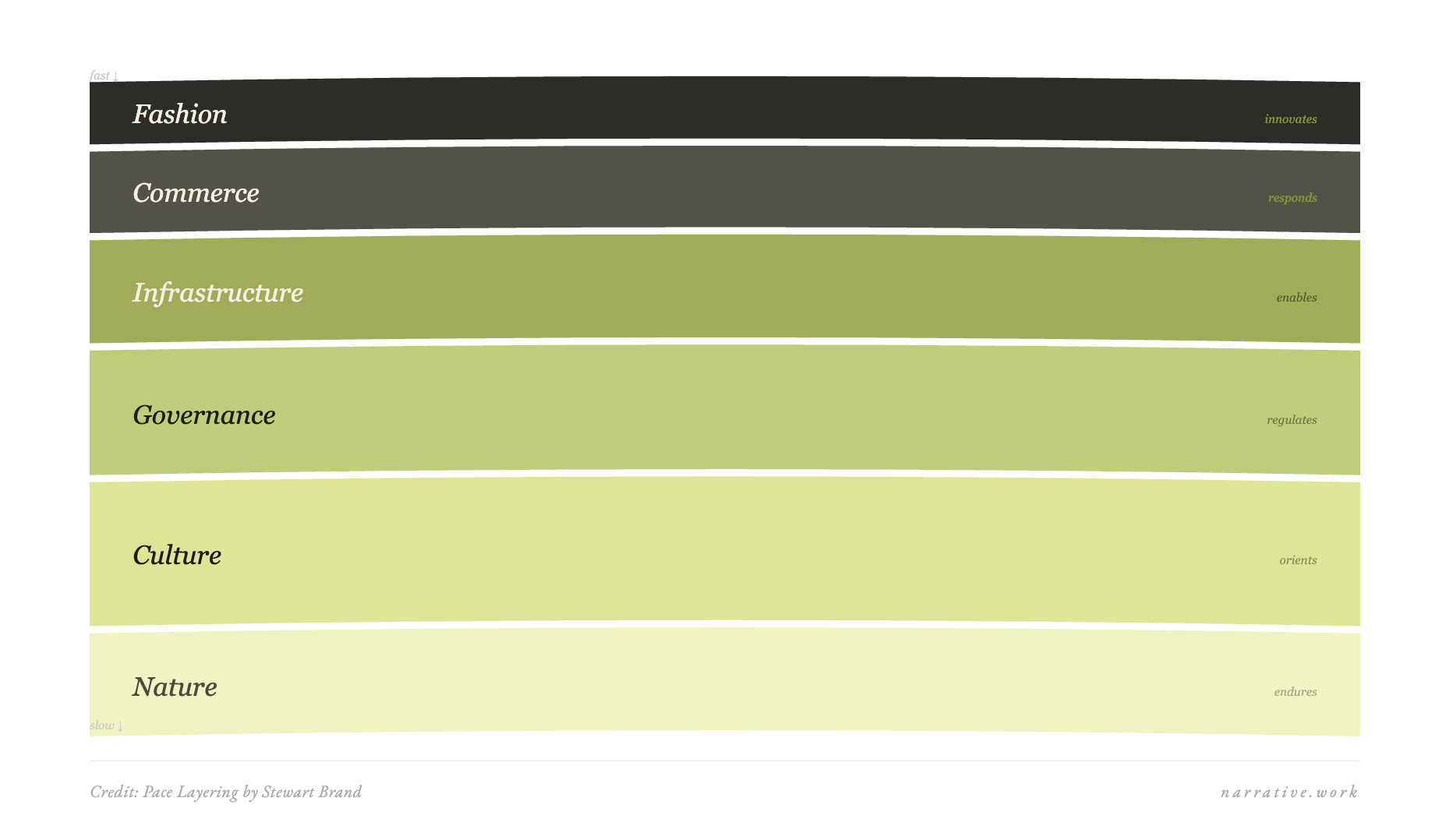
Through Stewart Brand’s pace layering framework (below) we get a reminder of where things move fast and slow and how if we interpret the fashion layer - or what shows up in the world at speed - we visibly see all that comes before what actually goes into something before it shows up.
The desire to remain relevant or be a category leader is strong. If you can just copy and slap it on top then everyone can do it.
And, I am not suggesting the company wanting the brand marketing leader that worked at either Aesop or A24 or Wieden+Kennedy will fail; just sharing a reminder that what eventually shows up and interacts with the world (and your customer) is downstream of so much more.
Long story short: You can’t just hire your way to a culture you haven’t built.